
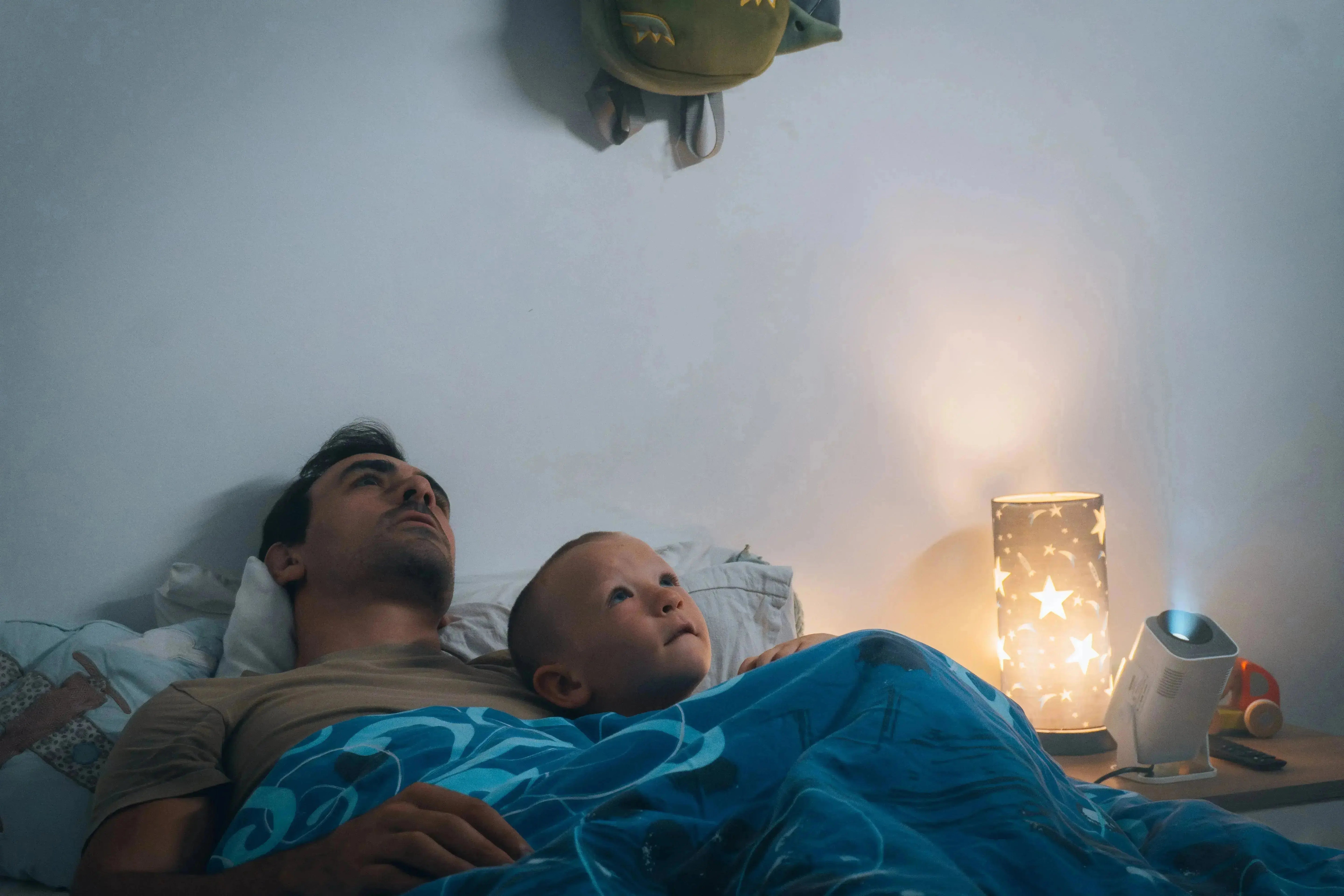
A bedtime routine checklist for kids turns the end of the day into a short sequence everyone can see and follow. Instead of trying to remember every step when the family is already tired, parents can use one familiar bedtime routine for getting ready, sharing a quiet moment, and finishing the evening.
Quick answer: Keep a bedtime routine checklist short and realistic. Washing, pajamas, brushing teeth, a quiet family moment, reading or revisiting something familiar, and a recognizable goodnight sequence can be enough. A consistent bedtime routine is about familiarity, not perfection.
A simple bedtime routine checklist for kids
Use this checklist as a starting point, then change the order or wording to match what your family actually does.
| Step | Bedtime routine |
|---|---|
| 1 | Wash or bathe |
| 2 | Put on pajamas |
| 3 | Brush teeth and use the bathroom |
| 4 | Share a quiet family moment |
| 5 | Read, tell a story, or revisit something familiar |
| 6 | Finish with the same familiar goodnight sequence |
You do not need all six steps. A useful bedtime routine checklist is one your family can repeat without making the evening unnecessarily complicated.

Why use a bedtime routine chart or checklist?
Bedtime already includes several small things that need to happen. A bedtime routine chart simply makes the sequence visible.
It can be useful when:
- different caregivers share bedtime
- children like knowing what comes next
- the family is building a new bedtime routine
- bedtime regularly becomes open-ended
- siblings share several steps
- parents want the main steps to happen in the same order
A chart can also help parents notice when the routine has become too long. If there are ten or twelve separate steps, it may be possible to combine or simplify some of them.
For a broader guide to evening structure, see our bedtime routines for kids article.
What research says about consistent bedtime routines
The American Academy of Sleep Medicine has reported findings from a large multinational survey examining bedtime routines in young children. More consistent routines were associated with several sleep measures, including bedtime timing, sleep duration, and night waking.
You can read the American Academy of Sleep Medicine summary.
The important distinction is that the research shows associations. A bedtime checklist cannot guarantee a good night’s sleep, and the chart itself is not a sleep treatment.
Its practical purpose is much simpler: help the family keep a recognizable sequence.
How many steps should a bedtime routine checklist have?
There is no single correct number.
Focus on the main transitions rather than listing every tiny detail. Four to six broad steps will often be easier to follow than a crowded chart.
For example, you do not need separate checklist items for finding the toothbrush, adding toothpaste, brushing, rinsing, and putting the toothbrush away.
One step can simply say:
Brush teeth.
For young children who are becoming more involved in their own routine, the wording could be:
Brushing their teeth and getting ready for bed.
The checklist should make the evening clearer rather than create another long list of instructions.
Pictures, words, or both?
The best bedtime routine chart format depends on how your family wants to use it.
| Checklist style | When it may be useful |
|---|---|
| Pictures with short words | When simple visual cues make the steps easier to recognize |
| Words with checkboxes | When children enjoy marking each step as it is completed |
| Simple written list | When the chart is mainly a shared family reminder |
| Blank customizable chart | When the family's routine is different from the example |
Keep the design simple enough that the main steps are easy to see at a glance.
Put the routine in the same order your family uses
A consistent bedtime routine is easier to follow when the chart reflects real family life.
If your family reads before brushing teeth, put those steps in that order. If bath time does not happen every night, do not build the entire checklist around a bath.
Start by writing down what normally happens on an ordinary evening. Then remove unnecessary steps and put the remaining ones in the same order they usually happen.

Where should you put a bedtime routine chart?
Put the chart somewhere the family naturally sees during the routine.
That might be:
- in the bedroom
- near the bathroom
- in a hallway between the bathroom and bedroom
- another familiar place where the bedtime routine begins
There is no one correct location. If the chart is regularly forgotten, simply move it somewhere more practical.
How bedtime routines fit into wider sleep schedules
A bedtime routine and a sleep schedule are related, but they are not the same thing.
Sleep schedules involve the wider timing of sleep, such as bedtime, waking, and daytime rest. The bedtime routine is the smaller sequence that happens before the final goodnight.
For example:
| Sleep schedule | Bedtime routine |
|---|---|
| When bedtime usually happens | What happens before bedtime |
| When the child normally wakes | Washing, pajamas, and brushing teeth |
| Daytime rest or naps where relevant | Reading, quiet family time, and goodnight |
The checklist does not need to manage the whole sleep schedule. Its job is to organize the final part of the evening.
Small healthy habits that can sit inside the routine
A bedtime checklist can also make practical healthy habits easier to remember without adding more complexity.
These might include:
- washing
- putting on clean pajamas
- brushing teeth
- getting the bedroom ready
- dimming the lights as the evening winds down
These are ordinary parts of family life rather than promises of a particular sleep outcome.
How to introduce the checklist
It can help to introduce the chart before everyone is tired.
- Look through the steps together.
- Explain that the chart shows what comes next.
- Point out the parts your family already does.
- Use it as a reference during the bedtime routine.
- Change anything that does not work in real life.
The checklist does not need to become another rule to enforce. It is simply a reminder of the family sequence.
Make room for connection too
Not every checklist step needs to be practical.
A short cuddle, conversation, story, prayer, or quiet moment together can give the routine space for connection between parent and child.
Some families think of this as parent-child bonding, while others simply see it as a familiar part of ending the day together.
The key is to keep it manageable enough that it remains part of the routine rather than becoming another long step.
What if your child keeps asking for one more thing?
Another drink, another book, another question, or another cuddle can quickly make bedtime feel open-ended.
A bedtime routine checklist can help define what the routine includes before it begins.
For example:
Choose one book → read together → goodnight
Limited choices can also fit inside the routine:
- choose between two books
- choose between two sets of pajamas
- choose whether the song comes before or after the story
Both options still lead toward the same clear ending.
For more on repeated delays or leaving the bedroom, see our bedtime resistance in children guide.
What if the bedtime routine changes?
A bedtime routine chart should support family life rather than make it rigid.
Travel, celebrations, late dinners, illness, and busy family evenings can all change the sequence.
On those nights, keep a shorter version available:
- Wash
- Pajamas and teeth
- One quiet family moment
- Story
- Goodnight
The routine becomes shorter while the broad sequence stays familiar.
Can siblings use the same bedtime routine chart?
Yes, if enough of their routine is shared.
Siblings might:
- get ready together
- brush teeth at the same time
- share one story
- have separate final goodnight moments
If their routines are substantially different, individual charts may simply be easier.
Can a calm learning moment go on the checklist?
If learning is already part of your family's evening rhythm, it can be one simple step on the checklist.
For example:
Story or calm learning moment
That might mean revisiting a letter sound, counting together, listening to a short story, or returning to something familiar from earlier in the week.
The Ozmotic Learning projection-based learning tool uses wall or ceiling projection for guided learning moments across letters, numbers, stories, languages, science, and other early learning subjects.
Families can browse the Ozmotic Learning content library to choose lessons that fit naturally into their learning-at-home routine.
Ozmotic Learning should be an optional part of the family rhythm rather than something that makes the bedtime routine longer or more complicated.

Quick bedtime routine checklist
If you want the shortest version to copy, start here:
- Wash or bathe
- Put on pajamas
- Brush teeth and use the bathroom
- Share a quiet family moment
- Read, tell a story, or revisit something familiar
- Finish with the same recognizable goodnight
Then remove, reorder, or adapt anything that does not fit your household.
Final thoughts
A bedtime routine checklist for kids does not need to promise healthy sleep or solve every difficult bedtime. Its job is much simpler: make the familiar evening sequence easier to see, remember, and repeat.
Start with a few steps. Keep them in the same order where practical. Include simple healthy habits, make room for family connection, and keep a shorter version for busy evenings.
For a routine designed specifically around the preschool years, see our preschool bedtime routine guide.

Share:
Spaced Repetition for Kids: A Simple Guide to Spaced Practice
Regular Sleep Schedule for Toddlers: Bedtime, Wake Time and Naps