
A simple hola can open the door to a new language. It is friendly, useful and easy to share.
Children do not need a long vocabulary list to start learning Spanish. A few familiar words are enough for a first step.
At Ozmotic Learning, we like to begin with what fits naturally into family life. A morning greeting can gently introduce Spanish.
A friendly place to begin
Try starting with three to five words connected with familiar people, objects or routines.
Say each word clearly, explain its meaning and use it again when the moment returns.
There is no need to remember everything immediately. Understanding can come before saying a word independently.
Research summarized by ACTFL also highlights the importance of the amount and quality of exposure when learning another language. Its Impact of Early Language Learning research brief offers a useful overview of what research says about language learning across childhood.
Easy Spanish words for kids
The most useful first words fit naturally into family life. Greetings, colors and small numbers provide clear starting points.
Greetings and kind words
Greetings are easy Spanish words to introduce because families can use them regularly.
- Hola: Hello
- Adiós: Goodbye
- Por favor: Please
- Gracias: Thank you
- Buenos días: Good morning
Try hola when entering a room, buenos días in the morning and adiós when leaving.
Words for family and home
Family and home vocabulary has personal meaning, which can make these useful first words for children who are beginning.
- Mamá: Mom
- Papá: Dad
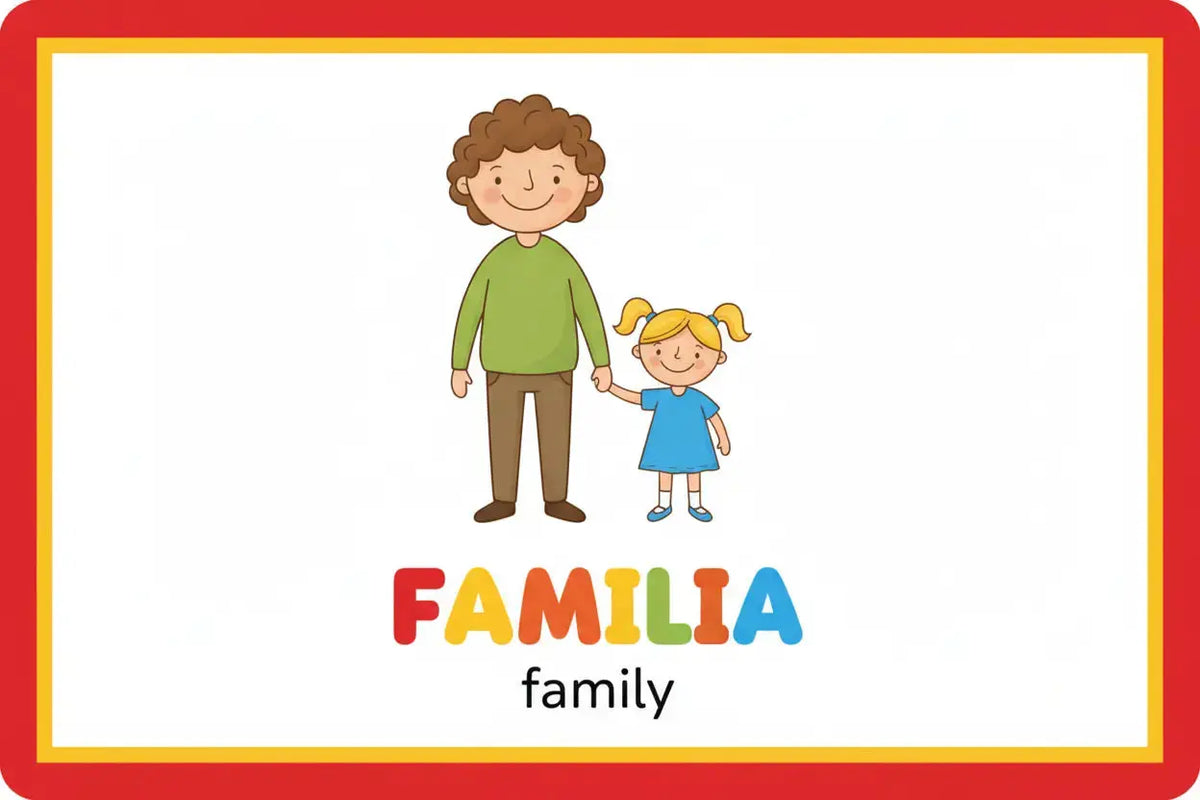
- Familia: Family
- Casa: House or home
- Agua: Water
Point to the person or object as you speak. The moment itself can help make the meaning clear without a lengthy explanation.
First color words
Colors connect Spanish vocabulary with something a child can already see.
- Rojo: Red
- Azul: Blue
- Verde: Green
- Amarillo: Yellow
Notice one color in different places. You might say, “The cup is azul. Azul means blue.”
Numbers from one to five
Small number words fit naturally beside counting your child already understands.
- Uno: One
- Dos: Two
- Tres: Three
- Cuatro: Four
- Cinco: Five
Count a small group in English, then repeat the total in Spanish. A familiar amount keeps the focus on the new language.
How to teach Spanish words at home
If you are wondering how to teach beginner vocabulary, think of it as sharing words together rather than working through a long list.
A calm exchange gives your child time to listen, understand and respond in their own way.
Choose one small word group
Begin with greetings, colors or family words instead of mixing several themes together.
Stay with the group for a few days. Add another word when the first ones begin to sound familiar.
Connect words with real moments
Use agua when pouring water or rojo when noticing something red. The moment supplies the meaning.
This keeps Spanish words and phrases connected with family life instead of becoming an isolated vocabulary list.
Move from one word to a short phrase
Once a word feels familiar, use a short phrase. You could move from hola to hola, mamá.
There is no need to explain grammar straight away. The phrase simply shows how familiar words can sit together.
Revisit instead of testing
Bring a word back naturally rather than asking your child to recite everything from memory.
If they forget, say it again naturally. Gentle repetition keeps the exchange useful and relaxed.
For more ideas on revisiting familiar learning over time, see our guide to learning repetition for kids.
What about Spanish pronunciation?
You do not need to be fluent to explore Spanish with your child. Learning alongside them is perfectly reasonable.
Listen to reliable pronunciation before introducing an unfamiliar word. The Cambridge entry for hola provides its meaning and spoken audio.
If you know a native speaker, you can also ask how they say a word. Their pronunciation may reflect their region.
Spanish is spoken across many countries, so vocabulary and pronunciation can vary. A different version is not necessarily incorrect.
What if my child does not remember?
Forgetting new words is normal. Simply repeat the word and reconnect it with what it represents.
A child may understand a word before saying it independently. Recognition and spoken use do not always arrive at exactly the same time.
Returning to fewer words can also make it easier to decide what to revisit next.
For broader ideas on conversation and early language at home, see our toddler language development at home guide.
Spanish vocabulary with Ozmotic Learning
During a projected language lesson, pause when something familiar appears. Say the Spanish word and connect it with what is visible.
The projection provides a visual starting point while families guide the conversation and explore each new word together.
Families can explore the Ozmotic Learning content library to see subjects available through projection-based learning.
Frequently asked questions
What Spanish words should children learn first?
Start with words that have an immediate use, such as hola, gracias, mamá, papá and agua.
How many words should I introduce at once?
Try a small group of related words to begin. Three to five can be a manageable starting point, but there is no need to follow a fixed number. Revisit familiar words before adding more.
Can I start learning Spanish with my child?
Yes. Check reliable meanings and pronunciation, then learn the words together. You do not need to pretend that you already know every answer.
Should I correct every pronunciation mistake?
Not necessarily. Model the word clearly and give your child another chance to hear it. Keeping the exchange conversational can be more useful than correcting every attempt.
Begin with one useful word
Choose one word for today. Say hola in the morning, use agua at lunch or count uno, dos, tres.
There is no need to hurry. A few useful words, shared warmly and revisited over time, are enough to begin.
Share:
Science Questions for Preschoolers: Simple Ways to Observe, Predict, and Wonder
Subitizing for Preschoolers: Seeing Small Amounts Without Counting