
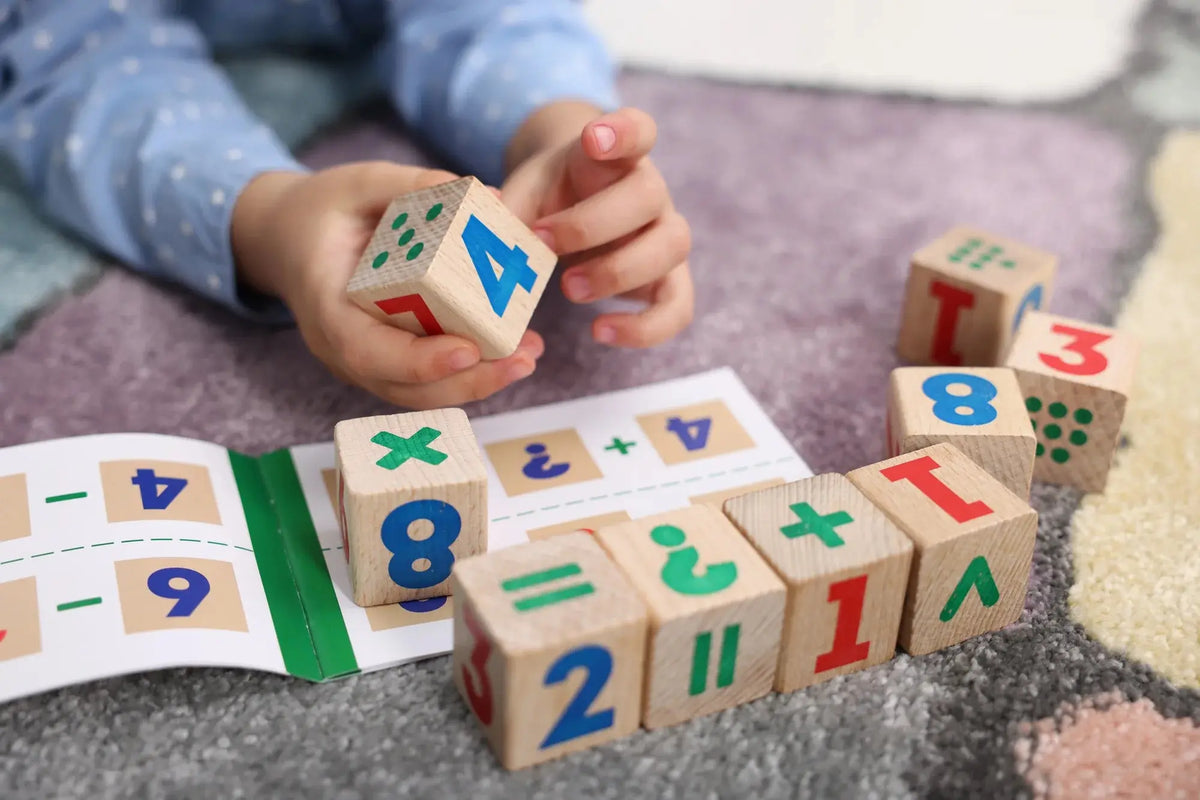
Knowing the number sequence and counting a group of objects are not quite the same skill. A child may be able to say “one, two, three, four, five” from memory and still find it difficult to keep track of objects while counting.
One-to-one correspondence is the early math idea that each object being counted is matched with one number word, one at a time. It helps children connect the spoken counting sequence with a specific quantity in front of them.
For families, the concept is simple to notice in everyday moments: point to one spoon and say “one,” touch the next and say “two,” then continue until each object has been counted once.
Quick answer: what is one-to-one correspondence?
One-to-one correspondence means matching one item with one other item or one number word. In early counting, it usually means assigning one number word to each object in a group.
If there are four blocks, the child touches or moves the first block while saying “one,” the second while saying “two,” and continues until all four have been counted.
Why one-to-one correspondence is an early math skill
Counting involves more than remembering a sequence of number words. Children also need to coordinate those words with the objects they are counting.
This is why one-to-one correspondence is considered an important early math skill. It helps connect counting language with actual quantities.
Stanford’s Development and Research in Early Math Education resources describe one-to-one correspondence as the principle that each object being counted should receive one and only one number word.
Stanford DREME’s counting guidance offers a useful explanation of how this idea fits into early counting development.
Rote counting and one-to-one counting are different
Rote counting means saying number words in the correct order from memory.
A child who can rote count to ten may know the sequence very well: one, two, three, four, five, and so on.
But counting a real group requires another step. The child needs to match each spoken number with one object.
What rote counting looks like
A child says the number sequence without needing objects in front of them.
What one-to-one counting looks like
The child points to, touches, or moves each object while saying one number word.
Each object is counted once, and no object is skipped.
A simple comparison
| Skill | What the child does | Example |
|---|---|---|
| Rote counting | Recites number words in order | “One, two, three, four, five” |
| One-to-one correspondence | Matches one number word to each object | Touches five blocks one at a time while counting |
| Cardinality | Understands that the final number tells how many are in the group | After counting five blocks, answers “five” when asked how many |

What one-to-one correspondence skills look like
One-to-one correspondence skills become visible when a child can keep a steady match between the objects in front of them and the words they say.
For example, a child may touch four familiar household objects, saying one number for each, then stop when the final object has been counted.
Touching each object once
Touch can provide a clear marker for which item has already been counted.
Encourage the child to touch one object as each number word is spoken.
Moving objects into a counted group
Another option is to move each item from one side of the table to the other as it is counted.
This can make it visually clear which objects still need a number and which have already been counted.
Lining objects up before counting
A scattered group can be harder to track than a row.
When the focus is learning the counting principle, arranging objects in a line can reduce the chance of skipping one or counting it twice.
How to teach one-to-one correspondence at home
Start with a small set of familiar objects and model the match between one spoken number and one object.
Step 1: begin with a small group
Start with two, three, or four objects so the child can see the whole group easily.
A small set keeps attention on the matching process rather than on remembering a long number sequence.
Step 2: model one number at a time
Touch or move the first object and say “one.” Move to the next and say “two.”
The physical movement and spoken number should happen together as clearly as possible.
Step 3: let the child try the same set
After modelling, reset the objects and invite the child to count them.
If an item is skipped, simply restart or rearrange the group. The moment can stay calm and low-pressure.
Step 4: ask “How many?”
After the final object is counted, ask how many there are altogether.
This begins connecting one-to-one counting with the idea that the final number represents the quantity of the whole group.

Everyday examples of one-to-one correspondence
You can count cups before setting the table, match one sock with another, or place one spoon beside each bowl.
At an early age, one-to-one correspondence may appear in very simple moments, such as giving one cup to each person or counting a small group of familiar objects.
Count food at snack time
If there are a few crackers on a plate, count them one at a time.
You might ask for the correct number of crackers for each place setting, then count together to check the quantity.
Match one object to one place
Place one napkin beside each plate or one spoon next to each bowl.
This shows one-to-one correspondence without requiring the child to recite a long count.
Use blocks or counters
Put down a small group of blocks and ask the child to move each one while counting.
Once this feels familiar, change the arrangement so the child has to keep track of a less orderly group.
Use dot stickers as visual markers
Dot stickers can create clear spaces for matching. Put four dots on a sheet and place one counter, button, or other safe object on each dot.
Why moving objects can make counting easier to follow
Moving an object as its number is spoken gives the child a visible way to track the count.
It also requires coordinating motor movement with the number sequence, but that movement is a support for the math rather than the main learning goal.
If small pieces make hand control difficult, use larger objects that are easier to touch and move.
What about hand-eye coordination and fine motor skills?
Some counting examples naturally involve hand-eye coordination or fine motor skills because children are pointing, placing, or moving objects.
Those skills can be part of the experience, but they should not make the counting task unnecessarily difficult.
If handling dot stickers or small counters becomes the main challenge, switch to larger blocks or household objects so the focus stays on one-to-one correspondence.

Common one-to-one correspondence errors
Mistakes can show which part of the counting process is still becoming familiar.
They are useful information, not a reason to increase pressure.
Skipping an object
A child may move through a group too quickly and leave one item uncounted.
Try lining the objects up or moving each counted item into a new group.
Counting the same object twice
This is common when objects are scattered.
A clearer arrangement or moving counted objects aside can make it easier to see what remains.
Number words run ahead of the objects
Sometimes a child recites the rote count faster than they can point.
Slow the spoken sequence so one number is clearly assigned to one object.
The pointing runs ahead of the number words
The opposite can also happen: the hand moves across several objects while fewer number words are spoken.
Model a slower rhythm where each movement and number word happen together.
How one-to-one correspondence supports number sense
Number sense is a broad understanding of numbers, quantities, and how they relate to one another.
One-to-one correspondence contributes to that bigger picture because it helps connect number words with actual groups.
Connection to number recognition
Number recognition focuses on identifying written numerals.
A child may recognise the symbol 5 while still learning how to count five objects accurately.
Our guide to number recognition for preschoolers explores that connection between numerals and amounts in more detail.
Connection to subitizing
Subitizing means recognising a small quantity without counting each item one by one.
That is different from one-to-one counting, where each object receives a number word.
Both contribute to children's growing understanding of quantity. Read more in our guide to subitizing for preschoolers.
Connection to cardinality
Cardinality is the understanding that the final number said when counting tells how many objects are in the group.
If a child counts “one, two, three, four” and then answers “four” when asked how many, they are connecting the count with the total quantity.
Connection to comparing quantities
Once children can count groups more reliably, they can begin comparing specific quantities.
A parent might ask, “Which group has more?” or “Do these groups have the same number?”
A simple one-to-one correspondence progression
A useful progression is simply to make the counting situation a little more complex as the basic match becomes familiar.
Stage 1: small, clearly arranged sets
Use two to four objects in a line and count each one slowly.
Stage 2: slightly larger groups
Add more objects while keeping the arrangement clear.
Stage 3: less orderly arrangements
Spread the objects out so the child has to keep track of what has already been counted.
Stage 4: count, then state the total
After counting, ask “How many altogether?” to connect the sequence with the quantity.

Does a child need to count perfectly?
No. Early counting develops over time, and errors can be part of learning how number words and objects correspond.
The useful question is not whether every count is perfect, but whether the child is beginning to understand the one-number-for-one-object relationship.
Is this a test of cognitive skills or critical thinking?
One-to-one correspondence is best understood as a specific early math concept rather than a general measure of cognitive skills or critical thinking.
A child can find the coordination of objects and number words difficult for many ordinary reasons, including the arrangement of the objects or the length of the count.
Keep the focus on modelling the mathematical relationship clearly instead of treating errors as a broader judgement about ability.
How Ozmotic Learning can fit into early math routines
Ozmotic Learning uses projected lessons to help families revisit early concepts such as numbers, quantities, shapes, and patterns during calm learning-at-home routines.
For one-to-one correspondence, projected number language can sit alongside real-object counting. The important practical step is still giving each object one number word as the child counts.
Families can explore more number and early math content on the Ozmotic Learning mathematics page.
Keep one-to-one counting clear and calm
The simplest way to remember one-to-one correspondence is: one object, one number word, one at a time.
Begin with a small group, let the child touch or move each object, and keep the spoken count matched to the movement.
As the idea becomes more familiar, change the number of objects, their arrangement, or the everyday context.
If you want to explore the broader counting picture next, see our guide to counting for preschoolers and our overview of preschool math at home.
Share:
Phonemic Awareness vs. Phonics: What Families Need to Know
Blending Sounds: How Early Readers Join Sounds Into Words