
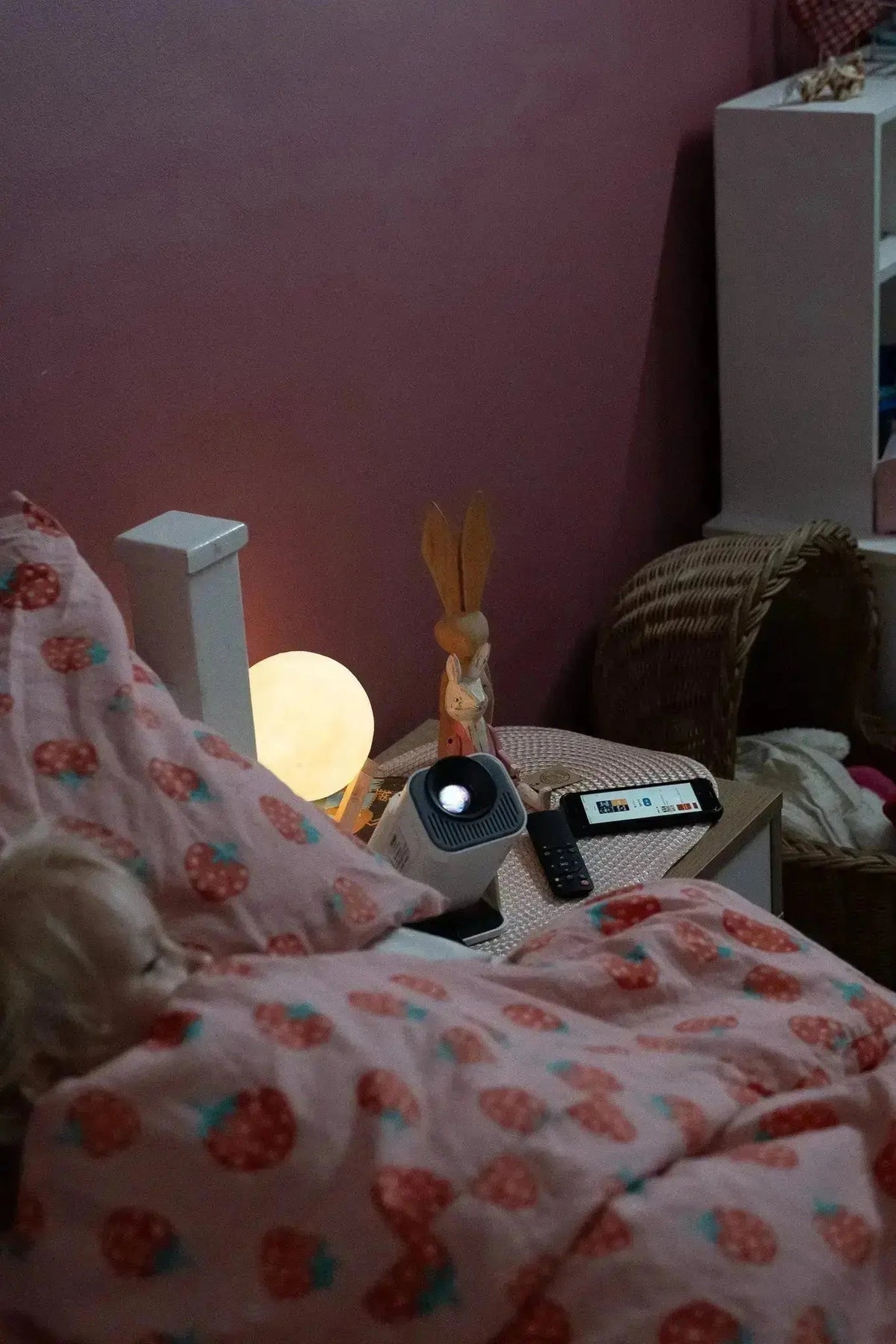
Audio visual learning for toddlers brings together what children see and what they hear during a guided learning moment. At home, that might mean hearing a word while seeing the person, object, picture, or projected example it refers to, then talking about it together.
Quick answer: Audio visual learning can give young children more than one cue to notice during learning. The most useful approach keeps the content clear, gives children time to respond, and includes parent conversation rather than relying on presentation alone.
What is audio visual learning for toddlers?
Audio visual learning for toddlers simply means that auditory and visual information are presented together.
For example, a child might:
- hear the word “bird” while seeing a bird
- hear a letter sound while seeing the letter
- listen to a short story while seeing the characters and sequence
- hear a number word while seeing the matching quantity
The sight and sound provide two parts of the same learning moment.
Parent conversation can then add another layer by naming, describing, repeating, or connecting the idea with something already familiar.

What research says about seeing and hearing language together
Researchers have studied how young children use auditory and visual information when learning words.
One study, The Role of Audiovisual Speech in Fast-Mapping and Novel Word Retention in Monolingual and Bilingual 24-Month-Olds, examined how toddlers responded to newly introduced words when auditory speech was accompanied by visual speech information.
The study included three experiments. The results showed that toddlers could use audiovisual information during word-learning tasks, although retention differed depending on how the visual information was available during learning and later recognition.
The takeaway should therefore stay modest. The research suggests that young children can use information they see as well as information they hear during language learning. It does not mean that adding visuals to every lesson guarantees stronger vocabulary or language outcomes.
Why parent conversation still matters
Audio visual learning does not need to be a one-way experience.
A parent can take something the child has just seen and heard and turn it into a short conversation.
For example:
- Name it: “That is a window.”
- Describe it: “The window is open.”
- Connect it: “We have a window in this room too.”
- Invite a response: “Can you find our window?”
The child does not need to answer every question correctly. Pointing, looking, making a sound, repeating part of a word, or simply listening can all be ways of taking part.
The NHS also recommends talking with young children throughout ordinary family routines, expanding on what they say, sharing books, and giving them time to respond. Its guidance on chatting and building sentences offers useful examples.
Try a simple see, hear, talk sequence
You can keep an audio visual learning moment very simple:
| Step | What happens | Example |
|---|---|---|
| See | The child notices the visual example | A projected picture of an elephant |
| Hear | The word or idea is spoken clearly | “Elephant” |
| Repeat | The important word appears again | “A big elephant” |
| Talk | The parent adds a simple connection | “What color is the elephant?” |
This keeps the learning moment focused on one idea rather than adding too much information at once.

What should audio visual learning content look like?
Clear content is usually easier to talk about than material with many competing elements.
Look for:
- One clear focus: a recognizable word, concept, story, or example
- Simple narration: language that is easy to hear and follow
- Uncluttered visuals: enough visual information to understand the idea without unnecessary distractions
- Useful repetition: important words or concepts returning naturally
- Room for conversation: moments where the parent can pause, name, describe, or respond
The aim is not to make the learning moment more intense. It is to make the idea clear enough to notice and revisit.
Repetition can happen across different learning moments
A word or concept does not have to appear only once.
A child might hear the word “triangle” during a projected lesson, notice a triangle in a book later, and recognize a similar shape somewhere else in the home.
Each encounter gives the family another opportunity to revisit the same idea in a slightly different context.
For more on this approach, see our learning repetition for kids guide.
Audio visual learning does not replace interaction
The most useful role for visual and auditory content is to give families something to notice and talk about together.
It should not replace conversation, shared reading, family routines, or the many other ways young children encounter language during the day.
Parents can use the content as a starting point:
- name what appears
- repeat one useful word
- describe what is happening
- connect it with something familiar
- pause and give the child time to respond
This keeps the learning experience parent-guided rather than passive.
Where Ozmotic Learning fits
Ozmotic Learning uses wall or ceiling projection to combine visual lessons with clear audio during guided family learning moments.
The Ozmotic Learning projection-based learning tool includes lessons across letters, numbers, phonics, stories, languages, science, and other early learning subjects.
A parent can pause on an idea, name what appears, repeat an important word, or connect the projected lesson with something the child already recognizes.

Families can browse the Ozmotic Learning content library to explore different subjects and revisit familiar lessons where useful.
For more about the thinking behind Ozmotic Learning, visit our Science page.
How this differs from broader language learning at home
Audio visual learning is only one part of the wider language environment children experience.
Conversation during meals, shared books, familiar family routines, songs, storytelling, and ordinary back-and-forth communication all provide opportunities to hear and use language.
Our toddler language development at home guide looks more broadly at parent conversation, parallel talk, reading together, and other ways language can become part of daily family life.
This separation is useful: this article focuses specifically on combining sight and sound, while the broader language guide focuses on the wider home language environment.
When parents have concerns about communication
Children develop communication skills in different ways and at different rates.
The ideas in this article are general learning-at-home suggestions. Audio visual learning and Ozmotic Learning should not be treated as speech therapy or as a way to diagnose, prevent, or treat a communication difficulty.
If a parent has ongoing concerns about a child's speech, language, hearing, or communication, a pediatrician, speech-language professional, or another qualified professional can provide individual guidance.

Final thoughts
Audio visual learning for toddlers can be kept simple: present one clear idea, let the child see and hear it, repeat what matters, and make room for conversation.
The value is not in adding more and more content. It is in giving families another way to share calm, guided learning moments and revisit early words and concepts together.
Share:
Subitizing for Preschoolers: Seeing Small Amounts Without Counting
Phonemic Awareness vs. Phonics: What Families Need to Know